
Showing posts with label San Bernardino County Board of Supervisors. Show all posts
Showing posts with label San Bernardino County Board of Supervisors. Show all posts
Tuesday, April 16, 2019

Wednesday, March 27, 2019
I AM AN ANIMAL CONTROL OFFICER
I AM YOUR ANIMAL CONTROL OFFICER
I am your animal control officer.
I am not the dreaded "dog catcher" or the "murderer" you call me.
I’m not the one who allows your pets to breed, then dumps the unwanted puppies and kittens on roadsides and in shelters.
I’m the one that must find the tiny animals before they die of starvation, exposure or disease and, as an act of mercy, exterminate them.
It hurts me to be forced to kill hundreds of thousands of animals each year, but because of YOUR irresponsibility, I have no choice.
I’m not the one who abandons unwanted animals on the farm roads, telling myself that some friendly farmer will surely take them in and give them a safe home. But I am the one who picks up the frightened animals who waits in vain for its beloved master, wondering why it has been abandoned.
I am the one who must help that friendly farmer trap, tranquilize, or kill that animal because it has begun to roam in packs with other abandoned, hungry animals, killing livestock, fowl, and game.
I am not the one who breeds and fights dogs in the name of “sport”. But I am the one who fights breeders and participants, and must pick up the dead and dying animals that have been left behind.
So remember, the next time a stray dog bites your child, your trash is dumped and scattered, your pet is lost, stolen, poisoned, or hit by a car, it is the Animal Control Officer you call. Not the “dog catcher”.
The next time your pet is picked up, or you are cited for neglecting or abusing it, remember that I am only trying to get you to fulfill your responsibility to your pet, your neighbor and yourself. Do not scorn me.
Respect me, for I am the product of your irresponsibility.
I love animals, and I care.
I love animals, and I care.
Sunday, March 24, 2019
A DOG IN A SHELTER WAS EUTHANIZED
A dog in a shelter was euthanized.
A dog that spent months and months in a cage because certain volunteers fell in love.
A dog who was extremely large and extraordinarily unpredictable.
A dog who tried to attack, yes attack, a few different employees and volunteers.
Who actually landed a bite to an employee's face.
And the guilt trip begins.
Why is it that those that make the most noise about an animal being euthanized NEVER bring that animal home?
Is it because deep down you know how unpredictable that animal is or what it may be capable of?
Is it because your children and personal pets shouldn't be put in harm's way?
Then why should you ask another to take that risk?
I really don't know the answer because the dogs I fell in love with and were at risk, I brought them home.
And let me tell you, some were squirrelly as hell after months in a cage.
But I put my money where my mouth was and adopted them.
I have also held other dogs for euthanasia. Dogs that were wonderful with me but would pose a risk and a danger to the general public. And I knew they were finally finding peace from whatever demons they had endured.
I will never be an advocate of placing out a dangerous dog. In my profession I've seen the aftermath far too many times.
Did my heart break with every euthanasia?
Absolutely.
Am I at peace with those decisions?
Absolutely.
You may very well disagree with me, but I certainly feel it was the humane thing to do.
The RESPONSIBLE thing to do.
A dog living in a cage for months and months on end is not a life. Waiting for one of the very few people who can handle you to visit every now and then and take you for a walk.
It's hell on earth.
So yes, a dog was euthanized.
In order to keep people from harm.
To free him from his inner demons.
And I would like to think that he is running far and free. Free from his anger, free from his chain link kennel, free from whatever tortured his soul.
And until those who make the most noise regarding euthanasia and dangerous animals start taking those very animals home, they should take a seat.
When you go online to make that very shelter look bad. When you don't tell the entire story. When you had almost an entire year to find that dog a home, or better yet GIVE him a home.
Shame on you and all the others who loved him so but not enough to take him home.
"The decision to euthanize must be made in the best interests of the dog. He is living in the present. It is a human’s responsibility to make sure the dog is not living in what the dog would consider hell. It is selfish to keep a dog alive if he has deteriorated emotionally or behaviorally, or his mental health is gone. It is unfair to offer to the public a dangerous dog or one who will be a behavioral nightmare for life."
Tuesday, July 3, 2018
THE PASSING OF A FRIEND - JEANNE KROEGER
It is with regret that this informs you of the passing of a friend of the Devore shelter - Jeanne Kroeger.


Jeanne Kroeger worked for the County of San Bernardino for 20 years from 1985 through 2005. Jeanne always had a love for animals and was originally hired as the Animal Shelter Supervisor for the County’s new animal shelter facility in 1985. She was also a certified veterinary technician and taught for a number of years at a local college. She was promoted to the position of Program Manager or Director of the San Bernardino County Animal Care and Control program and was instrumental in advancing a variety of programs that are still in place today to help animals in San Bernardino County, California.
There are two specific programs that Jeanne initiated that require mentioning. The first is the San Bernardino County spay/neuter voucher program that provides financial assistance to help residents obtain affordable spay/neuter surgeries for their pets. This program has assisted pet owners in sterilizing thousands of dogs and cats, which has prevented the births of numerous unwanted puppies and kittens. Jeanne was recognized on the tenth anniversary of this national award winning program by POPCO in 2011.
The second was the formation of a non-profit organization, the Animals aRe First Fund (ARFF), which assists in raising needed financial resources to support a variety of programs and efforts to help homeless animals. Jeanne was a founding member of ARFF in 2004 and it was one of her desires to establish this non-profit charity to benefit animals prior to her retirement in 2005. She requests that in lieu of flowers, donations be made to help animals. http://www.arffund.org/
Jeanne retired to the small Oregon coastal town of Waldport/Seal Rock. She was an artist at heart and taught classes at a local art gallery. She enjoyed her life in this scenic town working on her photography and in polymer clay. Please visit her site and enjoy her art. Her personality shines on.
Friday, June 29, 2018
REGULATION OF RESCUES TRANSPORTING DOGS
The State of Virginia has just passed a law regulating rescues and shelters about reporting to potential adopters about a previous history of bites with cats and dogs. This came about as a result of a horrendous attack by a newly adopted pit bull who killed within hours of adoption. The 'rescue' that adopted out this pit did so with a shock collar on it, and instructions to the new owner about removing the collar. As soon as the owner did remove the collar, the pit went after her mother and killed her. To top it all, this same rescue has many complaints and is still in business.
https://blog.dogsbite.org/2017/06/dog-bite-fatality-adopted-out-pit-bull-kills-virginia-beach.html
https://blog.dogsbite.org/2017/06/dog-bite-fatality-adopted-out-pit-bull-kills-virginia-beach.html
""Senate Bill 571 will become law on July 1st in the State of Virginia. The law requires releasing agencies to disclose all bite history for dogs and cats.
The releasing agencies must ask if the dog or cat has bitten a person or animal, including the date when the bite happened. The bite incident must then be documented.""
""RICHMOND, Virginia––The era of shelters and rescues concealing dog attack history from prospective adopters is over, says the Virginia state legislature, effective July 1, 2018.""
https://www.animals24-7.org/2018/05/30/virginia-bars-shelters-rescues-from-hiding-dogs-bite-history/
This is in addition to so many attacks and deaths by recently adopted dogs, especially pits.
We must do better adoptions. The movement of more adoptions is not the path, better adoptions. Pushing pets out the door to brag about numbers is unethical. Unfortunately the horrible Hayden Law forces this path on our shelters, no longer can all their experience dictate what is in the best interest of our pets and public safety. Please repeal the Hayden.
Thursday, September 7, 2017

Saturday, July 30, 2016

POOR CRUELTY LAWS IN WASHINGTON STATE, BUT PETS ARE STILL BEING SHIPPED THERE
Washington State has become the major dumping ground for pets pulled from Southern California shelters. Look at Olympia Sanctuary, OAS, Devore dogs were left there and when OAS was finally shut down, those dumping rescuers didn't go back for the Devore dogs.


The Shepherds Way fiasco, actual terrorists as well as a 'sanctuary' where California dogs were dumped. The well known attorney for these less than reputable rescues, Marla Tauscher, sent this poor dog to this place and now she won't do right and get that dog out of that place.

Now there is another one, another dumping ground for California rescuers/transporters. Outta sight, outta mind is the present day mentality of those following the No Kill movement. It is these people that are causing so much harm to the shelter pets.
""The reports show Gold dumped 50 dogs at the shelter simply because she had “too many dogs.” She also turned over 18 dogs to JAS for euthanization. Conversely, Furever Homes gets weekly deliveries of dogs indiscriminately pulled from shelters in California or taken off the streets of Mexico. Gold then tries to adopt out the dogs as quickly as possible, usually without a comprehensive medical exam or behavior testing.""

Rescue means taking a pet and providing it with better than it had. Not these days. These people aren't rescuers, they are the ones who make the problems. No KIll is slow kill, ship them to places like the above and forget about them. The state of the humane community is a disgrace these days.
Saturday, May 14, 2016
EXPOSURE TO RABIES, SPEND $12 INSTEAD, VACCINATE YOUR PETS
This piece delves into the cost of an unvaccinated dog that contracts rabies and bites.
When the mobile home residents took the mother dog to Town & Country Animal Hospital, Veterinarian Scott Chapman and other staff members (a total of nine) also were exposed to rabies and had to get expensive shots, for being what Chapman called “good Samaritans.”
When the mobile home residents took the mother dog to Town & Country Animal Hospital, Veterinarian Scott Chapman and other staff members (a total of nine) also were exposed to rabies and had to get expensive shots, for being what Chapman called “good Samaritans.”
Those were claimed at $800 each on insurance, he said; and every staff member also had to be inoculated.
If the shots have to include gamma globulin, he said, the bill increases to about $13,000.
He said some got the shots at PRMC’s lower cost, but at another Kerrville vet clinic, they paid workman’s comp.
“The doctors here had pre-exposure shots and when we were exposed we only had to get two more,” Chapman said.compensation $11,000 for post-rabies exposure shots.
“By comparison, at our area veterinarians’ offices, a pet’s rabies vaccine is about $12,” Chapman stressed.
Thursday, December 24, 2015
BEST OF THE HOLIDAYS TO THE STAFF AT DEVORE
This was a posting on facebook and I thought I would share with you.
I don't understand the outrage over Christmas and New Year's Eve, and the concept of employees having a nice Holiday being somehow offensive to people?
Shelter staff are human beings with feelings.
Why are people asking them, expecting them, to sacrifice their children's Christmas mornings, so that more "rescues" can have access to the dogs?
Why are people asking them, expecting them, to sacrifice their children's Christmas mornings, so that more "rescues" can have access to the dogs?
It's just a manufactured crisis wrapped up in a hoax, this story of evil shelter workers who refuse to work Christmas for the dogs, making it "impossible for rescues to rescue".
I am tired of the myth of rescues beating down the doors, and the shelter shutting them out so they can go celebrate the Holidays.
It's just not so..
It's just not so..
I'm sorry that the dogs landed in a high kill shelter.
Shelter workers didn't breed and dump these animals.
You'd think they did, by reading the FB comments on pages that ought to know better by now.
Shelter workers didn't breed and dump these animals.
You'd think they did, by reading the FB comments on pages that ought to know better by now.
If not for the shelter, these dogs would have nowhere to go.
Shelter cannot say no.
They cannot turn their backs
They never do.
But they do have to euthanize for space, or for behavior, or illness.
It is the RIGHT thing to do for those animals.
Shelter cannot say no.
They cannot turn their backs
They never do.
But they do have to euthanize for space, or for behavior, or illness.
It is the RIGHT thing to do for those animals.
The shelter staff sees and deals with things most cannot imagine.
Making them feel horrible for doing their job is a form of insanity and an exercise in futility.
And making them feel horrible for taking Christmas off when the City offers it as a benefit?
Please.
Shame on those people who are hating right now.
And making them feel horrible for taking Christmas off when the City offers it as a benefit?
Please.
Shame on those people who are hating right now.
The shelter employees deserve to have a Merry Christmas, and a Happy New Year..
I know you understand.
Maybe we can spread the word, combat the hatred, and gently remind people that we are all in the same boat.
Fighting Animal over population together.
Fighting Animal over population together.
Have a Blessed Holiday Season, and thank you all, so much, for caring about the shelter animals after they are pulled.
Monday, December 14, 2015
SAN BERNARDINO COUNTY LOOKING GOOD AGAINST MANY OTHER ANIMAL CONTROL AGENCIES
The 2014 Annual Report of Local Rabies Control Activities is out and I would like to do a comparison of San Bernardino County as a whole, compared to neighboring counties.
San Bernardino County 2014 (Incorporates all the individual agencies that have their own jurisdiction.)
Total live admissions for dogs - 39,933
Reclaimed - 5,402 or 13.5% of intake
Adopted - 21,322 or 53.4% of intake
Euthanized - 9,484 or 23.7% of intake
Total live admissions for cats - 30,580
Reclaimed - 284 or 1% of intake
Adopted - 9,800 or 32% of intake
Euthanized - 15,133 or 49.4% of intake
Riverside County 2014
Total live admissions for dogs - 39,037
Reclaimed - 6,700 or 17.2% of intake
Adopted - 12,729 or 32.6% of intake
Euthanized - 11.154 or 28.5%
Total live admissions for cats - 26,978
Reclaimed - 419 or 1.5% of intake
Adopted - 6,316 or 23.4% of intake
Euthanized - 18,126 or 67.2 of intake
Los Angeles County 2014
Total live admissions for dogs - 97,492
Reclaimed - 15,860 or 16.3% of intake
Adopted - 45,517 or 47.7% of intake
Euthanized - 20,068 or 20.5% of intake
Total live admissions for cats - 83,963
Reclaimed - 1,193 or 1.4% of intake
Adopted - 20,544 or 24.5% of intake
Euthanized - 44,092 or 52.5% of intake
Remember the statistics listed above are for all animal control agencies which provided reports in the respective Counties.
Now I will referenced Fresno. You may remember they contracted out animal control services to a private vendor and recently have now contracted with a “rescue group” to provide animal control and sheltering services. A newspaper story reflecting what is occurring in Fresno can be found at:
http://www.fresnobee.com/news/
Fresno 2014
Total live admissions for dogs - 21,289
Reclaimed - 2,414 or 11.3% of intake
Adopted - 4,947 or 23.2% of intake
Euthanized - 11.990 or 56.3%
Total live admissions for cats - 11,701
Reclaimed - 151 or 1.2% of intake
Adopted - 1,624 or 13.8% of intake
Euthanized - 9,147 or 78.1% of intake
As for the County of San Bernardino itself and it's owned shelters, the numbers are pretty good if you compare to the above agencies.
San Bernardino County owned shelters only 2014
Total live admissions for dogs - 5,667
Reclaimed - 631 or 11.1% of intake
Adopted - 3,985 or 70.3% of intake
Euthanized - 909 or 16% of intake
Total live admissions of cats - 4,605
Reclaimed - 37 or .8% of intake
Adopted - 1,474 or 32% of intake
Euthanized - 2,925 or 63.5% of intake
San Bernardino County 2014 (Incorporates all the individual agencies that have their own jurisdiction.)
Total live admissions for dogs - 39,933
Reclaimed - 5,402 or 13.5% of intake
Adopted - 21,322 or 53.4% of intake
Euthanized - 9,484 or 23.7% of intake
Total live admissions for cats - 30,580
Reclaimed - 284 or 1% of intake
Adopted - 9,800 or 32% of intake
Euthanized - 15,133 or 49.4% of intake
Riverside County 2014
Total live admissions for dogs - 39,037
Reclaimed - 6,700 or 17.2% of intake
Adopted - 12,729 or 32.6% of intake
Euthanized - 11.154 or 28.5%
Total live admissions for cats - 26,978
Reclaimed - 419 or 1.5% of intake
Adopted - 6,316 or 23.4% of intake
Euthanized - 18,126 or 67.2 of intake
Los Angeles County 2014
Total live admissions for dogs - 97,492
Reclaimed - 15,860 or 16.3% of intake
Adopted - 45,517 or 47.7% of intake
Euthanized - 20,068 or 20.5% of intake
Total live admissions for cats - 83,963
Reclaimed - 1,193 or 1.4% of intake
Adopted - 20,544 or 24.5% of intake
Euthanized - 44,092 or 52.5% of intake
Remember the statistics listed above are for all animal control agencies which provided reports in the respective Counties.
Now I will referenced Fresno. You may remember they contracted out animal control services to a private vendor and recently have now contracted with a “rescue group” to provide animal control and sheltering services. A newspaper story reflecting what is occurring in Fresno can be found at:
http://www.fresnobee.com/news/
Fresno 2014
Total live admissions for dogs - 21,289
Reclaimed - 2,414 or 11.3% of intake
Adopted - 4,947 or 23.2% of intake
Euthanized - 11.990 or 56.3%
Total live admissions for cats - 11,701
Reclaimed - 151 or 1.2% of intake
Adopted - 1,624 or 13.8% of intake
Euthanized - 9,147 or 78.1% of intake
As for the County of San Bernardino itself and it's owned shelters, the numbers are pretty good if you compare to the above agencies.
San Bernardino County owned shelters only 2014
Total live admissions for dogs - 5,667
Reclaimed - 631 or 11.1% of intake
Adopted - 3,985 or 70.3% of intake
Euthanized - 909 or 16% of intake
Total live admissions of cats - 4,605
Reclaimed - 37 or .8% of intake
Adopted - 1,474 or 32% of intake
Euthanized - 2,925 or 63.5% of intake
Friday, December 11, 2015
STOP THE DUMPING ONTO CANADA
Canada loosened their regulations on importing dogs during the Katrina crisis to help us. But the US has taken advantage of that. Canada has now their previous regulations in place. Are the transporters adhering to that? Nope. Scanning facebook posts, one can see that rescues show no concern for these regulations, no concern for bringing in diseased dogs, no concern for the Canada dogs that die from the taking of homes by imports. They even are tagging dogs as emotional support dogs. Lies, more lies, just so certain people can feed their egos. Many of the transported dogs are ending up in shelters in Canada. Many fall off the face of the earth.

Less than 8 months of age fall going to another rescue is a commercial category. So false paperwork is done listing foster homes as private adopters. Again, scanning facebook posts, this means that contrary to the public relations done by these transporters/rescues that the dogs have homes waiting for them, the dogs are actually up for grabs.
Demand regulation of these transports. Actually, demand that they stop. We can't continue to dump onto places that are still euthanizing for time and space. It is immoral and very unethical.

Less than 8 months of age fall going to another rescue is a commercial category. So false paperwork is done listing foster homes as private adopters. Again, scanning facebook posts, this means that contrary to the public relations done by these transporters/rescues that the dogs have homes waiting for them, the dogs are actually up for grabs.
Demand regulation of these transports. Actually, demand that they stop. We can't continue to dump onto places that are still euthanizing for time and space. It is immoral and very unethical.
Sunday, December 6, 2015
CANADA: MECCA FOR RESCUE OR EXCUSE FOR DOG FLIPPING?
In a series of three articles, Canadians are exposing the lack of regulations concerning transports of dogs into Canada and what is happening to these dogs.
The stories are heartwarming, saving a thousand dogs at Thanksgiving, flying them all over the country. But is it really that heartwarming? Inhumane transports, dumping with questionable 'rescues' in shopping center parking lots, is this what we want for our shelter pets? The highway to hell is paved with good intentions.
Series of 3 articles
The stories are heartwarming, saving a thousand dogs at Thanksgiving, flying them all over the country. But is it really that heartwarming? Inhumane transports, dumping with questionable 'rescues' in shopping center parking lots, is this what we want for our shelter pets? The highway to hell is paved with good intentions.
Series of 3 articles
Friday, December 4, 2015
NO SHELTER SHOULD TURN AWAY A VICIOUS DOG INTO THE COMMUNITY
A woman takes a pit bull to a shelter because it has become aggressive and she can't handle it. The shelter turns her away. A shelter's first priority should be the safety of the community, yet this shelter turned away a threat to their community. This is how No Kill works, how No Kill disregards the first priority of shelters and animal control, the first priority of community safety.
Why did this shelter turn away a vicious pit bull, what did the shelter think this woman would do with that vicious pit bull? What if she had kids at home?
""Later on Saturday, animal control officers received reports of a roaming pit-bull near Maltby Lake and looked for the animal, but it was too late."
Instead this explanation was offered by a member of law enforcement, of all people.
“We don’t have the facilities. We don’t have the resources to take all these animals and, especially if someone comes in and says, ‘Hey my dog is vicious.’ That’s not the city’s responsibility to take your dog that was mistrained.” Tamarro said.
Hey, you take the dog and euthanize it. What resources do you need to do that? This is the No Kill mentality. And West Haven Animal Shelter does list itself as No Kill.
http://www.nbcconnecticut.com/news/local/Police-Investigate-After-Pit-Bull-Owner-Tried-to-Give-to-Shelter-Dies-360106151.html
Why did this shelter turn away a vicious pit bull, what did the shelter think this woman would do with that vicious pit bull? What if she had kids at home?
""Later on Saturday, animal control officers received reports of a roaming pit-bull near Maltby Lake and looked for the animal, but it was too late."
Instead this explanation was offered by a member of law enforcement, of all people.
“We don’t have the facilities. We don’t have the resources to take all these animals and, especially if someone comes in and says, ‘Hey my dog is vicious.’ That’s not the city’s responsibility to take your dog that was mistrained.” Tamarro said.
Hey, you take the dog and euthanize it. What resources do you need to do that? This is the No Kill mentality. And West Haven Animal Shelter does list itself as No Kill.
http://www.nbcconnecticut.com/news/local/Police-Investigate-After-Pit-Bull-Owner-Tried-to-Give-to-Shelter-Dies-360106151.html
Sunday, November 8, 2015

Thursday, October 22, 2015
CANADA - STOP THE TRANSPORTS, WE HAVE ENOUGH HERE TO DEAL WITH !
Load 'em up, move 'em out, is the cry of the latest breed of scams - transporting.
Canada has become a dumping ground, and the Canadians can't figure out why. They know they have their own share of a pet overpopulation problem, so why is the rich country of the US dumping their unwanted pets there.
http://pawsforhope.org/paws-for-hope-condemns-bc-spcas-secret-internal-proposal-to-import-dogs-for-adoption/
“At first glance, B.C. residents may think this is a grand gesture by the BC SPCA to help more animals in need – wherever they may be – but if you read between the lines of this report, you’ll see that this is more about public appeal and financial support than provincial animal care,” stated Kathy Powelson, Executive Director of Paws for Hope. “We are concerned this confirms that the BC SPCA is unable to penetrate the hundreds of B.C. communities with severe animal welfare and dog overpopulation issues, including many that pay bounties to those that deliver the tails of stray dogs they kill. This is not a time to overlook what’s needed within B.C., the very province they’re supposedly here to serve.”
Public appeal and financial support. It also serves to stroke the egos. With the advent of the No Kill movement, what would have been classified as abusers and hoarders, have become 'rescuers' instead. Every week, horrible stories emerge about these 'rescues' who claim to be followers of No Kill. Shelters included too. Pets are becoming pawns in a deadly game of Dr. Feelgood.
This is a letter written to Wings of Rescue about their bringing in California pets. Wings of Rescue brought in diseased pets as well, putting Canadian pets in jeopardy with disease they don't deal with much there.
Shannon Cripps
Yesterday at 1:44pm
This is the email I wrote to Wings of rescue. I do not think it will be well received, or even acknowledged really but we shall see.
"I am a volunteer and board member with a Pit Bull specific rescue here in Alberta Canada. It was brought to my attention through several outlets today about a transport scheduled in early June you have facilitated. I read through your post online regarding your "When Pitties Fly" campaign and while I admire your dedication and commitment to saving these American dogs, I would like to ask you to take a few things into consideration before continuing your endeavor.
Our rescue group has been in the Alberta officially since 2005, specifically Calgary. We relocated to Edmonton in 2009 and have functioned province wide since. In the past 4 years, we have seen a literal explosion of bully breeders and importers alike, and it has come with a huge amount of concern and alarm in the past 2 years especially as we see the full circle impact both are having on our province. For approximately 3 months in 2013, our group imported a small number of dogs from California. We realized, in that brief period of time, that we were in fact having a very negative impact on our efforts to rescue and rehome local dogs and immediately ceased any and all operations pertaining to the importation of dogs into our group.
I would ask that you consider the following information when you choose to relocate dogs into Canada, and perhaps rethink the methods and feasibility of the mass transport of 200 plus dogs a year into our country.
First off, I need to address the one comment that prompted me to write this email at all; Canada does not have a shortage of pit bulls. This is a complete and utter fallacy and whatever source that information stemmed from is vastly misinformed. As a country, pit bulls in Canada are the number one euthanized dog nation wide, and while we may not show the staggering numbers you do in the US, I can assure you that we euthanize tens of thousands of them yearly in our country. Our group alone receives dozens of requests weekly to take pit bull type dogs from our local provincial shelters, clinics and humane societies, to say nothing about the massive numbers of requests we get from nation wide groups in the BSL province of Ontario where a complete ban on the breed still exists. It also needs to be said that the sheer numbers won't hold up for long as the province of Alberta is populated with approx 4 million people, while California holds a population of over 38 million. In fact, the entire population of Canada is still 3 million less than that of the state of California! Last year it was estimated that over 10,000 dogs were imported into Canada, while over 600,000 were euthanized in our shelters.
Secondly, we are seeing full circle what happens to many dogs brought up here. We have received numerous requests in the past 2 years since importation boomed to take in US dogs that have landed back in Canadian shelters. We get weekly pleas for help from adopters who cannot get assistance from their adoptive groups. In a worst case scenario, these animals are ending up on Facebook sale sites, Kijiji and Craigslist to be sold to another family. Usually, the reasons are the same as why they landed in the US shelters to begin with- behavior problems, health problems, lack of available housing, lack of training support from the adoptive rescues, financial hardship and the worst in my mind- the dog doesn't fit the family or isn't what it was represented as. It has become apparent that far too many of the rescues spearheading these imports are not capable, nor willing, to commit to the needs of both dogs and adopters long term. Poor rescue practices are being illuminated by these returns to the Canadian system and they are becoming the responsibility of other groups in the areas, pulling resources from our own dog population and in the worst cases, posing harm to our community health both animal and human.
We have recently (in the past 10 days) seen 5 separate dog attack incidents in Calgary, 3 of which are confirmed pit bull type dogs and one suspected pit bull. The temperature of acceptance towards pit bulls in the city is cooling rapidly in light of these recent events and BSL is once again on the table thanks to a very pro-BSL head of the animal bylaw department. In our own experience, many of these imported dogs are not sufficiently behaviourly assessed prior to placement, nor are they given suitable "down time" prior to adoption to ensure the best placement possible. Behaviour issues are being brought to us (and other non related groups) for help because the import rescue is unable to assist and lacks the resources needed to deal with the challenges. In some cases, this has resulted in dogs being surrendered to other rescues (again pulling resources from local dogs), or back into our shelters where they are most often euthanized.
It was recently highlighted in several online forums and discussions that most of the dogs imported into Canada are "cherry picked" as the best of the bunch available in the high kill shelters of the US, leaving the less desirable dogs behind to face their death. In essence, we are taking the most adoptable dogs out of the US and leaving behind the dogs most at risk anyways, thus not really improving their plight.
While I can understand the position you are in and we are all well aware how awful the outcome is for may pitties in US shelters, I hope that you will take the information I've shared with some consideration as to the long term implications of sending masses of dogs into Canada, where our population base is not any better equipped to handle more homeless pets than yours is."
This blog is addressing the problem of bringing disease. Authored by a well known Canadian vet who has concerns about the importation of diseases not prevalent in Canada.
http://www.wormsandgermsblog.com/?s=import
We need to think about why and how dogs are imported, and we need to address these questions:
Is there a net benefit to the dog population, or does importation harm local adoption efforts?
Is the vanity factor why most people get an imported dog? (Yes, you have a nice new phone, but look at Vladimir, my rescue dog from Siberia.)
Is it because there is truly an unmet need for certain dogs in North America?
Is it because there is inadequate education about the over-abundance of local adoptable dogs?
Do our lax importation rules create risk to our dog population and the public?
Georgia has just passed regulations addressing transports.


Canada has become a dumping ground, and the Canadians can't figure out why. They know they have their own share of a pet overpopulation problem, so why is the rich country of the US dumping their unwanted pets there.
http://pawsforhope.org/paws-for-hope-condemns-bc-spcas-secret-internal-proposal-to-import-dogs-for-adoption/
“At first glance, B.C. residents may think this is a grand gesture by the BC SPCA to help more animals in need – wherever they may be – but if you read between the lines of this report, you’ll see that this is more about public appeal and financial support than provincial animal care,” stated Kathy Powelson, Executive Director of Paws for Hope. “We are concerned this confirms that the BC SPCA is unable to penetrate the hundreds of B.C. communities with severe animal welfare and dog overpopulation issues, including many that pay bounties to those that deliver the tails of stray dogs they kill. This is not a time to overlook what’s needed within B.C., the very province they’re supposedly here to serve.”
Public appeal and financial support. It also serves to stroke the egos. With the advent of the No Kill movement, what would have been classified as abusers and hoarders, have become 'rescuers' instead. Every week, horrible stories emerge about these 'rescues' who claim to be followers of No Kill. Shelters included too. Pets are becoming pawns in a deadly game of Dr. Feelgood.
This is a letter written to Wings of Rescue about their bringing in California pets. Wings of Rescue brought in diseased pets as well, putting Canadian pets in jeopardy with disease they don't deal with much there.
Shannon Cripps
Yesterday at 1:44pm
This is the email I wrote to Wings of rescue. I do not think it will be well received, or even acknowledged really but we shall see.
"I am a volunteer and board member with a Pit Bull specific rescue here in Alberta Canada. It was brought to my attention through several outlets today about a transport scheduled in early June you have facilitated. I read through your post online regarding your "When Pitties Fly" campaign and while I admire your dedication and commitment to saving these American dogs, I would like to ask you to take a few things into consideration before continuing your endeavor.
Our rescue group has been in the Alberta officially since 2005, specifically Calgary. We relocated to Edmonton in 2009 and have functioned province wide since. In the past 4 years, we have seen a literal explosion of bully breeders and importers alike, and it has come with a huge amount of concern and alarm in the past 2 years especially as we see the full circle impact both are having on our province. For approximately 3 months in 2013, our group imported a small number of dogs from California. We realized, in that brief period of time, that we were in fact having a very negative impact on our efforts to rescue and rehome local dogs and immediately ceased any and all operations pertaining to the importation of dogs into our group.
I would ask that you consider the following information when you choose to relocate dogs into Canada, and perhaps rethink the methods and feasibility of the mass transport of 200 plus dogs a year into our country.
First off, I need to address the one comment that prompted me to write this email at all; Canada does not have a shortage of pit bulls. This is a complete and utter fallacy and whatever source that information stemmed from is vastly misinformed. As a country, pit bulls in Canada are the number one euthanized dog nation wide, and while we may not show the staggering numbers you do in the US, I can assure you that we euthanize tens of thousands of them yearly in our country. Our group alone receives dozens of requests weekly to take pit bull type dogs from our local provincial shelters, clinics and humane societies, to say nothing about the massive numbers of requests we get from nation wide groups in the BSL province of Ontario where a complete ban on the breed still exists. It also needs to be said that the sheer numbers won't hold up for long as the province of Alberta is populated with approx 4 million people, while California holds a population of over 38 million. In fact, the entire population of Canada is still 3 million less than that of the state of California! Last year it was estimated that over 10,000 dogs were imported into Canada, while over 600,000 were euthanized in our shelters.
Secondly, we are seeing full circle what happens to many dogs brought up here. We have received numerous requests in the past 2 years since importation boomed to take in US dogs that have landed back in Canadian shelters. We get weekly pleas for help from adopters who cannot get assistance from their adoptive groups. In a worst case scenario, these animals are ending up on Facebook sale sites, Kijiji and Craigslist to be sold to another family. Usually, the reasons are the same as why they landed in the US shelters to begin with- behavior problems, health problems, lack of available housing, lack of training support from the adoptive rescues, financial hardship and the worst in my mind- the dog doesn't fit the family or isn't what it was represented as. It has become apparent that far too many of the rescues spearheading these imports are not capable, nor willing, to commit to the needs of both dogs and adopters long term. Poor rescue practices are being illuminated by these returns to the Canadian system and they are becoming the responsibility of other groups in the areas, pulling resources from our own dog population and in the worst cases, posing harm to our community health both animal and human.
We have recently (in the past 10 days) seen 5 separate dog attack incidents in Calgary, 3 of which are confirmed pit bull type dogs and one suspected pit bull. The temperature of acceptance towards pit bulls in the city is cooling rapidly in light of these recent events and BSL is once again on the table thanks to a very pro-BSL head of the animal bylaw department. In our own experience, many of these imported dogs are not sufficiently behaviourly assessed prior to placement, nor are they given suitable "down time" prior to adoption to ensure the best placement possible. Behaviour issues are being brought to us (and other non related groups) for help because the import rescue is unable to assist and lacks the resources needed to deal with the challenges. In some cases, this has resulted in dogs being surrendered to other rescues (again pulling resources from local dogs), or back into our shelters where they are most often euthanized.
It was recently highlighted in several online forums and discussions that most of the dogs imported into Canada are "cherry picked" as the best of the bunch available in the high kill shelters of the US, leaving the less desirable dogs behind to face their death. In essence, we are taking the most adoptable dogs out of the US and leaving behind the dogs most at risk anyways, thus not really improving their plight.
While I can understand the position you are in and we are all well aware how awful the outcome is for may pitties in US shelters, I hope that you will take the information I've shared with some consideration as to the long term implications of sending masses of dogs into Canada, where our population base is not any better equipped to handle more homeless pets than yours is."
This blog is addressing the problem of bringing disease. Authored by a well known Canadian vet who has concerns about the importation of diseases not prevalent in Canada.
http://www.wormsandgermsblog.com/?s=import
We need to think about why and how dogs are imported, and we need to address these questions:
Is there a net benefit to the dog population, or does importation harm local adoption efforts?
Is the vanity factor why most people get an imported dog? (Yes, you have a nice new phone, but look at Vladimir, my rescue dog from Siberia.)
Is it because there is truly an unmet need for certain dogs in North America?
Is it because there is inadequate education about the over-abundance of local adoptable dogs?
Do our lax importation rules create risk to our dog population and the public?
Georgia has just passed regulations addressing transports.
GA - Of interest to rescue organizations, concerned advocates, and anyone engaged in the interstate rescuing of animals
Press Release on Persons Authorized to Obtain Animals on Behalf of Licensed Animal Shelters/Rescues
October 19, 2015
Persons Authorized to Obtain Animals on Behalf of Licensed Animal Shelters/Rescues
Anyone or any group that obtains animals from a licensed Animal Shelter/Rescue with the intent of re-homing the animal is required to apply for and obtain an "Animal Shelter License" from the Georgia Department of Agriculture.
Georgia Animal Protection Act Rule 40-13-13-.02 (9) states that The Commissioner may refuse to issue or renew or may suspend or revoke a license on any one or more of the following grounds:
(d) allowing a license issued under this chapter to be used by an unlicensed person
In Georgia, Animal Rescue Organizations are required to operate as a non-profit organization. To obtain the non-profit status they must be incorporated with the Georgia Secretary of State https://ecorp.sos.ga.
Georgia Department of Agriculture rule: 40-13-13-.01(5) defines what is considered to be an "Animal Shelter in Georgia and rule: 40-13-13-.01(30) defines what is considered to be an "Animal Rescue" in Georgia.
40-13-13-.01 (5) “Animal shelter” means any facility operated by or under contract for the state, county, municipal corporation, or any other political subdivision of the state for the purpose of impounding or harboring seized, stray, homeless, abandoned, or unwanted dogs, cats, and other animals; any veterinary hospital or clinic operated by a veterinarian or veterinarians which operates for such purpose in addition to its customary purposes; and any facility operated, owned, or maintained by a duly incorporated humane society, animal welfare society, or other nonprofit organization for the purpose of providing for and promoting the welfare, protection, and humane treatment of animals. Only government agencies or organizations that are contracted with a government agency to perform animal control services have the authority to impound animals.
40-13-13-.01 (30) “Rescue Group” means any association or corporation operated as a non-profit organization and for the purpose of providing care and shelter to animals. Except rescue groups for equine, a rescue group that takes possession of animals and provides care and shelter must be licensed as an animal shelter or under written contract with a licensed animal shelter, in which case it will be considered an agent for the animal shelter and not an animal shelter itself. An equine rescue group operating for that purpose and maintaining any facility (including, without limitation, providing temporary care at a person’s private property) must meet all the requirements of a licensed stable. Rescue groups are not authorized to impound animals unless they are contracted by a government agency in Georgia to provide Animal Control Services.
In order for a person to obtain animals from a County or municipal Animal shelter with the intent of re-homing that animals, they must be the corporate president, one of the corporate officers of the Licensed Rescue organization or a person that is authorized by the Rescue to obtain animals on their behalf.
To obtain animals on behalf of a licensed Animal Rescue organization the Rescue president or one of the corporate officers must certify the authorized person by presenting the Animal Shelter with an authorization letter approved by the Georgia Department of Agriculture. A template for this letter can be found at http://agr.georgia.gov/
The Authorization letter shall state: The name of the person that is obtaining the animal The persons address and phone number – email if available A form of personal identification The letter must be signed and dated by the authorized person and the Animal Shelter and will be kept on file at the Animal Shelter. This agreement may be terminated by either party at any time for any reason.
If at any time the Authorized person becomes "Unauthorized" to obtain animals on behalf of the licensed rescue, the President or corporate officers of the rescue must notify the Animal Shelter in writing within 7 days. A copy of the termination correspondence must be kept on file at the Animal Shelter. This correspondence may be by email; however, it must be signed by the President or Corporate officer of the licensed rescue.
Out of State Rescue organizations that are obtaining animals with the intent of rehoming them must apply for a non-resident license with theGeorgia Department of Agriculture Companion Animal Section. The contact number is 404-656-4914. The annual fee for a non-resident license is $400 annually. Out of State rescues must adhere to the same policy concerning the authorization of individuals that may obtain animals on their behalf. An additional requirement for non-resident Animal Rescue Organizations is to execute consent to the jurisdiction of the Courts in this State as outlined in O.C.G.A. § 4-11-6 § 4-11-6.
Applicability of article to nonresidents; consent to jurisdiction; service Any person who is not a resident of this state but who engages in this state in any activities for which a license is required by this article shall be subject to this article as to such activities. Each nonresident applicant for a license required by this article shall be required as a condition of licensure to execute a consent to the jurisdiction of the courts of this state for any action filed under this article; and service of process in any such action shall be by certified mail or statutory overnight delivery by the Commissioner.
A consent form template and application can be obtained on our website at:http://agr.georgia.gov/
This consent may be also be emailed with the license application to gdalicensing@agr.georgia.gov
An Animal rescue organization or transport may also be subject U.S.D.A. regulations (Animal Welfare Act). See regulations on our website.
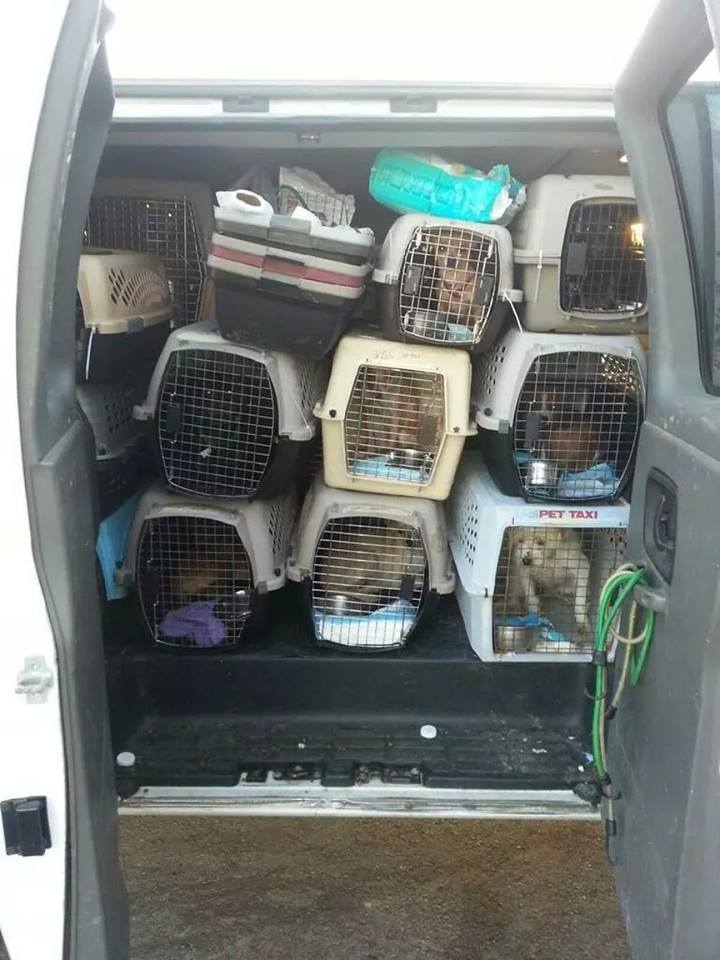
And to show you a typical transport, and ask if you think this is humane.
Wednesday, October 21, 2015
HATE DOESN'T PAY !!
For the past couple of years, the No Kill movement led by Nathan Winograd and No Kill Nation, have been in a condemnation campaign against PeTA. PeTA is standing alone on many fronts, TNR and pit bulls mainly.
The Huffington Post is enabling Winograd to pen poison articles about PeTA in his usual fashion of distorting the truth. Another came on the scene backing Winograd and No Kill Nation, Douglas Anthony Cooper, with scathing articles in the Huffington Post, articles with no credibility.
When PeTA was accused of stealing a dog and euthanizing it, No Kill made all kinds of accusations when in truth they were supporting the irresponsible dog owner. PeTA was never charged with anything. Within a day of learning of the incident, No Kill Nation wrote a letter to Sam Simon, creator of the Simpsons, trying to get his money. Sam Simon has always been a supporter of PeTA, a major player in Los Angeles for spay/neuter, and he was on his deathbed when No Kill Nation wrote that inappropriate letter to him appealing for him to leave them his money.
All this conniving by No Kill and No Kill Nation turned on them. It appears that their hatred for PeTA has driven followers from them and donations for PeTA rose while theirs fell. This does not include Sam Simon's estate.

http://delawarecapa.blogspot.com/2015/09/hate-doesnt-pay-but-good-deeds-do.html
The Huffington Post is enabling Winograd to pen poison articles about PeTA in his usual fashion of distorting the truth. Another came on the scene backing Winograd and No Kill Nation, Douglas Anthony Cooper, with scathing articles in the Huffington Post, articles with no credibility.
When PeTA was accused of stealing a dog and euthanizing it, No Kill made all kinds of accusations when in truth they were supporting the irresponsible dog owner. PeTA was never charged with anything. Within a day of learning of the incident, No Kill Nation wrote a letter to Sam Simon, creator of the Simpsons, trying to get his money. Sam Simon has always been a supporter of PeTA, a major player in Los Angeles for spay/neuter, and he was on his deathbed when No Kill Nation wrote that inappropriate letter to him appealing for him to leave them his money.
All this conniving by No Kill and No Kill Nation turned on them. It appears that their hatred for PeTA has driven followers from them and donations for PeTA rose while theirs fell. This does not include Sam Simon's estate.

http://delawarecapa.blogspot.com/2015/09/hate-doesnt-pay-but-good-deeds-do.html
Sunday, October 18, 2015
NATIONAL PIT BULL VICTIM AWARENESS DAY
The Inland Empire has suffered more deaths by pit bulls than any region in the country. We need to honor those victims on October 24th with a moment of silence.
NationalPitBullVictimAwarenessDay.org is set to raise awareness of the social and financial costs of pit bull attacks. The initiative, sponsored by Daxton’s Friends for Canine Education and Awareness, seeks to call attention to the scope and severity of this urgent public safety issue.
“Despite clear evidence that pit bulls are responsible for a substantially disproportionate number of attacks, maimings and deaths, humane groups and tax-payer funded animal shelters continue to encourage the public to adopt pit bulls by specifically promoting them through initiatives like Pit Bull Awareness Month.” According to Clifton’s research, since 2010, 30 pit bulls and 7 bull mastiffs adopted from shelters have killed people.

http://www.miheadlines.com/2015/10/18/pit-bull-crisis-prompts-support-groups-to-declare-october-24th-national-pit-bull-victim-awareness-day/
NationalPitBullVictimAwarenessDay.org is set to raise awareness of the social and financial costs of pit bull attacks. The initiative, sponsored by Daxton’s Friends for Canine Education and Awareness, seeks to call attention to the scope and severity of this urgent public safety issue.
“Despite clear evidence that pit bulls are responsible for a substantially disproportionate number of attacks, maimings and deaths, humane groups and tax-payer funded animal shelters continue to encourage the public to adopt pit bulls by specifically promoting them through initiatives like Pit Bull Awareness Month.” According to Clifton’s research, since 2010, 30 pit bulls and 7 bull mastiffs adopted from shelters have killed people.

http://www.miheadlines.com/2015/10/18/pit-bull-crisis-prompts-support-groups-to-declare-october-24th-national-pit-bull-victim-awareness-day/
Tuesday, October 13, 2015
TNR - IS IT SPREADING MENTAL ILLNESS AS WELL AS DISEASES?
We all realize that cats carry several diseases. Now recent studies show a link to mental illness. TNR, the movement that re-abandons cats, neglects the public safety issue, denies it even against the face of science.
http://www.iflscience.com/health-and-medicine/cat-parasite-linked-development-mental-illness-owners
"This study, published in the journal Schizophrenia Research, examines whether the ownership of a cat during childhood is more common in families with members who went on to develop mental health disorders later on in life. The researchers state that two earlier studies came to this conclusion and, using an extensive survey, attempted to replicate the finding. They were successful, reinforcing the link between early cat ownership and later-life schizophrenia and other serious mental illnesses."
http://www.medicalnewstoday.com/articles/284681.php
A few years ago in Los Angeles County, children in a daycare center were becoming ill. The illnesses were traced to a nearby feral cat colony.
http://knabe.com/2008/10/23/wild-cats-to-be-removed-from-rancho-los-amigos-after-increased-public-health-concerns/#.VB2d80pX-uY
Due to the large number of feral cats on the campus, estimated at 150 – 200, the Los Angeles County Department of Public Health (DPH) has determined that the current conditions pose a public health risk. Evidence of fleas, flies, and feces associated with the cats has been observed throughout the campus, including adjacent to a child day care center, a County Crime Laboratory, and a County Public Health Laboratory. Unmanaged colonies of feral cats could potentially pass on organisms related to human disease such as rabies, plague, endemic typhus, toxoplasmosis, and cat-scratch disease. These pathogens can be transmitted via bite, scratch, fleas, and exposure to fecal matter.
Beachgoers in Miami became infected with hookworms, again traced to a feral cat colony nearby.
"The thought to know that your child has a living larva in his skin is horrible," she told Miami Herald news partner WFOR-Ch. 4.
A girl in Northern CA contracted rabies from a feral cat.
The public health investigation identified contact with free-roaming, unvaccinated cats at the patient's school as a possible source of infection.
http://www.cdc.gov/mmwr/preview/mmwrhtml/mm6104a1.htm
With all of this, why are we allowing this movement to jeopardize the safety and well being of our citizens? TNR has evolved into nothing more than outside hoarding, it is rarely done properly. Food stations attract more than cats, attracting wildlife, attracting owned cats, luring them from their homes. TNR is not the way to help cats, it is the ultimate cruelty to re-abandon cats.
This new research probably explains the actions of many in the humane community who shouldn't be there.
http://www.iflscience.com/health-and-medicine/cat-parasite-linked-development-mental-illness-owners
"This study, published in the journal Schizophrenia Research, examines whether the ownership of a cat during childhood is more common in families with members who went on to develop mental health disorders later on in life. The researchers state that two earlier studies came to this conclusion and, using an extensive survey, attempted to replicate the finding. They were successful, reinforcing the link between early cat ownership and later-life schizophrenia and other serious mental illnesses."
http://www.medicalnewstoday.com/articles/284681.php
"A fifth of schizophrenia cases 'may be attributable to T. gondii infection'"
"Schizophrenia is one of the leading causes of disability in the US, affecting more than 3.5 million people."A few years ago in Los Angeles County, children in a daycare center were becoming ill. The illnesses were traced to a nearby feral cat colony.
http://knabe.com/2008/10/23/wild-cats-to-be-removed-from-rancho-los-amigos-after-increased-public-health-concerns/#.VB2d80pX-uY
Due to the large number of feral cats on the campus, estimated at 150 – 200, the Los Angeles County Department of Public Health (DPH) has determined that the current conditions pose a public health risk. Evidence of fleas, flies, and feces associated with the cats has been observed throughout the campus, including adjacent to a child day care center, a County Crime Laboratory, and a County Public Health Laboratory. Unmanaged colonies of feral cats could potentially pass on organisms related to human disease such as rabies, plague, endemic typhus, toxoplasmosis, and cat-scratch disease. These pathogens can be transmitted via bite, scratch, fleas, and exposure to fecal matter.
Beachgoers in Miami became infected with hookworms, again traced to a feral cat colony nearby.
"The thought to know that your child has a living larva in his skin is horrible," she told Miami Herald news partner WFOR-Ch. 4.
A girl in Northern CA contracted rabies from a feral cat.
The public health investigation identified contact with free-roaming, unvaccinated cats at the patient's school as a possible source of infection.
http://www.cdc.gov/mmwr/preview/mmwrhtml/mm6104a1.htm
With all of this, why are we allowing this movement to jeopardize the safety and well being of our citizens? TNR has evolved into nothing more than outside hoarding, it is rarely done properly. Food stations attract more than cats, attracting wildlife, attracting owned cats, luring them from their homes. TNR is not the way to help cats, it is the ultimate cruelty to re-abandon cats.
This new research probably explains the actions of many in the humane community who shouldn't be there.
Sunday, October 11, 2015
TRANSPORTS? ARE THEY BEING DONE HUMANELY?
Transporting of pets has become the biggest scam to hit the humane community. The movement of No Kill has created a new type of rescue, the Saviors. These types are given credibility by No Kill with the call of saving them all, quality of life be damned. The founder of No Kill himself, states the pets would be better off on the streets.
"The last place an animal advocate should wish an animal to end up, including those animals who live on the streets, is the local shelter. Life on the street is safer than a stay in an animal shelter." Nathan Winograd, March 12th, 2013
In steps the Saviors, pulling dogs from the shelters, and no accountability. Recently a man was arrested for raping dogs, dogs that he got from networking online. Dogs that were transported to him, no checks, no nothing, just get those dogs from the shelter and dump them on whoever will take them, including this rapist. The drama queen advocate over at the City shelter stated online that she had almost 300 mutual friends with this dog rapist. Can't help but wonder if she played a role in his acquisitions.
Here is another example of these transports.
"The encounter was familiar to police and animal control authorities, who say a multistate, lucrative network of questionable and illegal dog sales runs a pipeline of puppies from the South to the Northeast.
Dog sellers present the canines with heart-tugging tales of Southern kill shelters. They also describe residents of the South as uninterested in preventing unwanted puppies through regular spaying and neutering.
This is big money: at $300 per dog, a rescue operation that does not give the animals proper medical attention or humane transport conditions can make $420,000 a year for 1,400 dogs, said Raymond Connors, an animal control officer for the state.
"It's a multimillion-dollar industry," he said."

"The last place an animal advocate should wish an animal to end up, including those animals who live on the streets, is the local shelter. Life on the street is safer than a stay in an animal shelter." Nathan Winograd, March 12th, 2013
In steps the Saviors, pulling dogs from the shelters, and no accountability. Recently a man was arrested for raping dogs, dogs that he got from networking online. Dogs that were transported to him, no checks, no nothing, just get those dogs from the shelter and dump them on whoever will take them, including this rapist. The drama queen advocate over at the City shelter stated online that she had almost 300 mutual friends with this dog rapist. Can't help but wonder if she played a role in his acquisitions.
Here is another example of these transports.
"The encounter was familiar to police and animal control authorities, who say a multistate, lucrative network of questionable and illegal dog sales runs a pipeline of puppies from the South to the Northeast.
Dog sellers present the canines with heart-tugging tales of Southern kill shelters. They also describe residents of the South as uninterested in preventing unwanted puppies through regular spaying and neutering.
This is big money: at $300 per dog, a rescue operation that does not give the animals proper medical attention or humane transport conditions can make $420,000 a year for 1,400 dogs, said Raymond Connors, an animal control officer for the state.
"It's a multimillion-dollar industry," he said."
A million dollar industry that nets almost nothing for our shelters and for the most part, costs our taxpayers.
And here is how many of those are carried. Do you think they receive potty breaks along the way?

We are told that other areas are desperate for these transports. Really? I think not. Most are begging California to stop these transports, especially Canada. It is an unregulated business that is harmful to the animals and to areas still suffering a pet overpopulation problem, a problem that No Kill followers deny. Thus they can justify their actions to their conscious, if they have one.
"It was basically an unregulated industry, and anyone could do it," Connors said. "We saw people setting up in parking lots or strip malls and adopting dogs out for $300. Now, when animals are imported into the state of Connecticut, the person needs to be licensed with the Department of Agriculture, and they need to have an agent in the state."
Contact your officials at the State level and ask them to take on this issue. Regulate at the very least these unscrupulous grifters who think they are heros. Save our shelter pets, please, from these people.
Subscribe to:
Posts (Atom)